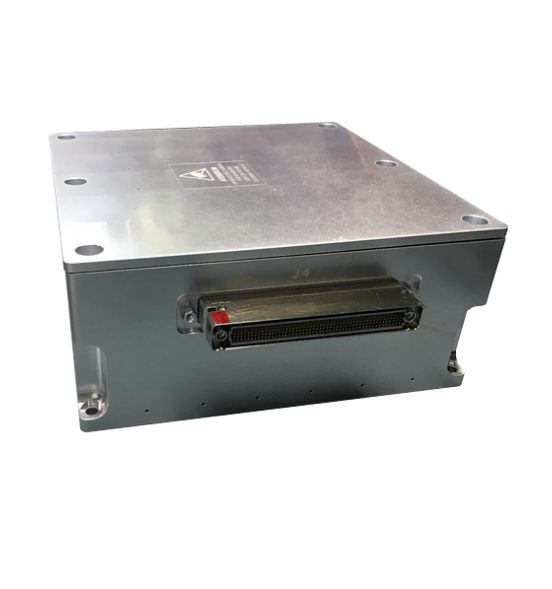
4K FPIE
infrared focal plane interface electronic, designed for space sensors in space environments
→ lead mechanical engineer on program — structural/fatigue/thermal analysis and integration 🛠️
→ nov 2025 - present 📅
role
I am the lead mechanical engineer on the program, responsible for structural, fatigue, and thermal analysis and for integration of the assembly.
what I was handed
A flight assembly carried a ceramic column grid array with more than a thousand solder columns. Underfill had been applied beneath the package before I picked up the work. It was never part of the functional design intent — it had been added as an interim measure to buy fatigue margin on the solder columns under the program’s vibration, shock, and thermal environments.
When the underfill was implicated in reliability problems and the decision came down to remove it, the fatigue margin it had been providing went away with it. The requirements did not change. I owned closing that gap.
how I framed it
Because the assembly already existed, my options were narrow. The underfill was cured onto the PCBA under the CGA, between thousands of columns; removing it without damaging the board is not realistic. This was also the first R&D build, and the remaining PCBAs were mostly complete, so there could be no change on the PCBA itself. That was only survivable because underfill is one of the last steps in PCBA assembly and had not yet been applied to the rest of the boards.
That left one realistic lever: make the chassis stiffer to reduce deflection, and in turn reduce fatigue accumulation from the vibration and shock environments. The usual way to stiffen a board — adding mounting points — was off the table, since the boards were already largely assembled.
the change I made
I thickened the base of the chassis to reduce chassis deflection, which in turn reduces PCB deflection. That was only affordable because I still had over 25% weight margin against the customer requirement.
A thicker bottom wall shrinks the internal cavity, so I ran a clearance check against the tallest mounted components at nominal and at worst-case tolerance stackup, and confirmed positive clearance throughout.
Modeling the columns
Before I could model the CGA columns I had to establish their material composition, deriving effective properties from the combination of materials involved. I then modeled each individual column — with thousands of them, that became a computing and meshing problem. Column geometry is small relative to the assembly, and the stress result is sensitive to how it gets discretized, so I applied tighter mesh controls to the column geometry and ran a convergence study on the highest-stressed columns to prove the stresses I was reporting were converged and not an artifact of mesh density. I was signing my name to these numbers and I wanted to know they held up.
what I found
Shock-induced fatigue of the solder columns dropped to essentially zero with the stiffer chassis. I expected that.
Random vibration was more interesting, and it is the part of this project I learned the most from. Stiffening the chassis cut the stress amplitude per cycle, which helps. But it also raised the assembly’s fundamental resonant frequency, and a higher fundamental means more stress cycles accumulate over the same exposure duration. Those two effects push in opposite directions on cumulative damage, so I could not assume the stiffening was a net win until I ran both.
It was. The final cumulative damage index came in below the allowable limit, I maintained positive margins of safety for all structural components across the full load environment, and I demonstrated that the assembly meets its fatigue requirements with the underfill removed.
My takeaway
Stiffness is not a free variable in a fatigue problem. Adding it changes both how hard each cycle hits and how many cycles you accumulate. I don’t assume the direction of that result anymore.
outcome
a stiffer chassis with near-zero shock deflection and reduced overall fatigue stress without underfill — which also makes the PCBA manufacturing process, and any future rework, considerably easier.